
On (a)symmetry
or: the desert is the sand

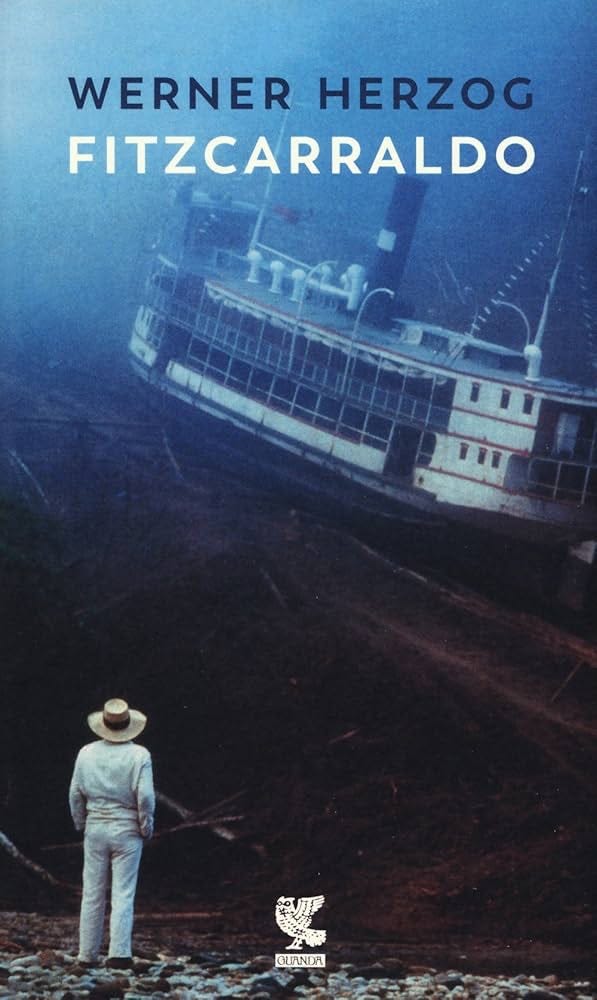
In the suffocating humidity of the Peruvian rainforest, a 320-ton steamship slowly ascends a muddy mountain, defying gravity, logic, and the very architecture of the terrain. This image, immortalised in Werner Herzog’s Fitzcarraldo, is a triumph of guerrilla filmmaking and a profound metaphysical provocation. It is the human Will externalised, rendered in iron and sweat, forcing its idiosyncratic desires upon a silent, unyielding topography. Such defiance in Herzog’s work is not confined to celluloid fictions; it is a lived ontology. In the bitter winter of 1974, upon learning that his mentor Lotte Eisner was dying in Paris, Herzog set out on foot from Munich. Possessing little more than a compass, a duffel bag, and a fierce, irrational conviction, his diary, published as Of Walking in Ice, reveals this act of magical voluntarism: the absolute belief that the physical endurance of his body walking through snowstorms could bar the gates of death from opening.
Herzog’s cinematic universe is awash with a specific friction: the collision between the absolute infinitude of human intentionality and the monumental, icy indifference of objective reality. He presents us with a world where the human will is a magnificent rejection of the ontological fabric of the universe. Whether hauling iron over a mountain or placing one boot in front of another across a frozen continent, Herzog returns again and again to the relationship between Mind and Being. Philosophers have long tested and played with the boundaries of the Will. There is a tragic, beautiful friction between the infinite expanse of human intentionality (the Will) and the stubborn, unyielding indifference of Mind-Independent Reality (the World). This week, dear reader, we’re starting with volitional asymmetry.
Before Herzog, Schopenhauer posited that the fundamental fabric of reality is not a rational design, nor a collection of stable physical matter. Rather, underlying all phenomena is a blind, ceaseless, and irrational striving- a metaphysical force he called the Will and detailed in his masterwork The World as Will and Representation. For Schopenhauer, the material universe (including human intellect) is a surface-level representation of a deep cosmic hunger. The human mind is not a detached observer of reality; it is a localised flare-up of this rhapsodic, chaotic energy [a feeling we have explored in ‘Rhythms of biological motion, or: the whirlpool in the river’].
When Herzog’s protagonists plunge into their obsessions, they are not behaving irrationally; they are embodying the Schopenhauerian Will in a pure, and thus volatile, form. When Fitzcarraldo demands a mountain yield to a steamship, or when Herzog himself demands in Of Walking in Ice that crossing a frozen continent will alter the biological reality of Lotte Eisner’s mortality, we witness a radical magical voluntarism. This is an ontological posture that assumes that the internal momentum of human consciousness possesses a sovereign right over the physical laws of the universe.
[Cosmic Will (Blind Striving)] ➔ [Localised Human Obsession] ➔ [The Volitional Assault on Physics]
This is where the poetry of the Herzogian worldview bleeds into academic metaphysics. The walk from Munich to Paris is not a logistical journey, but an act of somatic metaphysics. Herzog turns his own body into a localised engine of intentionality, attempting to generate enough spiritual and physical friction to warm a cold universe and stop time itself. In this framework, the human Will does not only navigate reality; it controls it.
The profound tragedy and beauty of this philosophy lies in its inevitable collision with what contemporary metaphysics terms Radical Ontological Realism. While the Schopenhauerian Will rages inside the human chest, the external world seems to operate on a completely different frequency. The mind-independent reality that Herzog encounters on the ice or in the jungle is not actively malicious, it is something worse: it is entirely indifferent.
In Of Walking in Ice Herzog writes of a world stripped of human sentiment, a bleak, frozen landscape of dead crows, abandoned houses, and unyielding blizzards. This is nature as an ontological void, completely blind to human meaning or historical gravity. The snowstorm does not care about the artistic genius of Lotte Eisner. The mountain in Peru does not care about the beauty of opera. This reflects the metaphysical position of Object-Oriented Ontology and speculative realism, which denies humanity a central place in the universe. The universe is composed of objects and forces that exist entirely outside our cognitive grasp, operating on independent trajectories that remain fundamentally deaf to our emotional or spiritual outcries.
When human intentionality collides with this radical realism, an asymmetrical fracture occurs. On one side we have the infinitude of desire: our minds can conceptualise infinity, defeat death, and move ships over mountains. On the other side, the finitude of being: the physical universe enforces strict boundaries of entropy, gravity, and decay. The asymmetry lies in a stark imbalance of scope, capacity, and vulnerability. When looking at this specific philosophical friction, the external, mind-independent reality is exponentially bigger, while the human Will is vastly smaller.
Herzog’s work highlights this friction. The madness of his characters (and tbh maybe his own madness during the winter walk of 1974) arises from the sudden, jarring realisation of volitional asymmetry. We are creatures possessing boundless metaphysical desires yet it seems we may be trapped inside an unfeeling, mechanistic reality that does not even register our existence.
How does the finite human Will survive its collision with an infinite, indifferent universe? For Herzog, the answer is not submission, but metaphysical reframing. He famously rejects the "truth of accountants", that is, the mere collection of literal, empirical facts, in favour of what he terms "ecstatic truth". In his 1999 Minnesota Declaration, Herzog asserted that literal facts hold no deep illuminative power; they are more like surface ripples of a pond. To reach the depths, one must wilfully manipulate the surface.
This pursuit of ecstatic truth is an act of ontological revision. It is the assertion that reality is not a fixed, objective landscape to be passively recorded, but an interactive canvas that requires human imagination to yield its deepest meanings. When Herzog directs a documentary, he doesn’t just observe; he scripts scenes, stylises dialogues, and invents historical quotes. Critics have often accused him of fabrication, but this is like accusing a curator of not creating the art- the critics here are missing the point. And anyway, through a philosophical lens, he is performing a vital cosmic duty: he is forcing a chaotic, silent reality to speak a human language. To put it logically:
[Empirical Facts / "Accountant's Truth"] ➔ Altered via Myth & Narrative ➔ [Ecstatic Truth / Deep Meaning]
see also: ‘nobody ever died for the ontological argument’
This ontological bending is vividly present in Of Walking in Ice. As Herzog walks through the bleak European landscape, the physical world begins to warp under the pressure of his singular intent. He describes the landscape not through the objective eyes of a surveyor, but through the heightened, mythic lens of a visionary. The dead crows, the abandoned tractors, and the howling blizzards are elevated into cosmic omens. He writes, "Our paths are built on myth, not asphalt."
By transforming his physical journey into a mythological pilgrimage, Herzog performs an essential metaphysical theft: the World asserts a brutal winter journey that will likely end in exhaustion, while a friend dies miles away in a hospital bed. The Will demands a sacred, Faustian bargain where every mile walked acts as a shield against death.
This is the essence of ecstatic truth. It is the poetic manipulation of so-called ‘reality’ to create an alternative ontological framework- one where human suffering, beauty, and will are granted central, cosmic importance. We weave narratives, invent myths, and superimpose poetry onto the cold fabric of space and time. We do this not because we are ignorant of objective reality, but because the literal truth is an existential vacuum. Ecstatic truth is the ultimate tool of the human Will; it is the poetic weapon we use to carve a home out of an otherwise uninhabitable cosmos.
The friction Herzog encounters on the ice is mirrored precisely in the most profound unsolved problem in mathematics: the P versus NP question. At its core, this problem asks a deceptively simple question about the universe: is finding a solution to a problem fundamentally harder than verifying a solution that someone else has already found? In computer science, P represents problems that can be solved quickly and efficiently (in polynomial time). NP represents problems whose solutions might be incredibly difficult to find, but are effortlessly easy to verify once presented.
If P = NP, it would mean that the universe possesses a magical fluidiy. As the computer scientist Scott Aaronson observed, a world where P = NP is one where any creative or analytical feat is cheap; anyone who can appreciate a beautiful symphony could instantly compose one, and discovering a brilliant scientific cure would be no more difficult than checking if the cure works. It would completely collapse the gap between conceptualisation and materialisation.
When Herzog’s protagonists engage in their obsessions, they are effectively operating under the beautiful delusion of a P = NP reality. Herzog's walk from Munich to Paris is an attempt to exploit a cosmic loophole. He presents a belief that the sheer, profound concept of Lotte Eisner’s survival (the easily verified, ideal state of grace) could effortlessly override the brutal, step-by-step physical calculations of biological decay. It is the belief that the Will can act as a mathematical shortcut, bending physics through the sheer intensity of human desire. Eisner survived to see Herzog’s arrival and lived nine more years. QED, P = NP ?